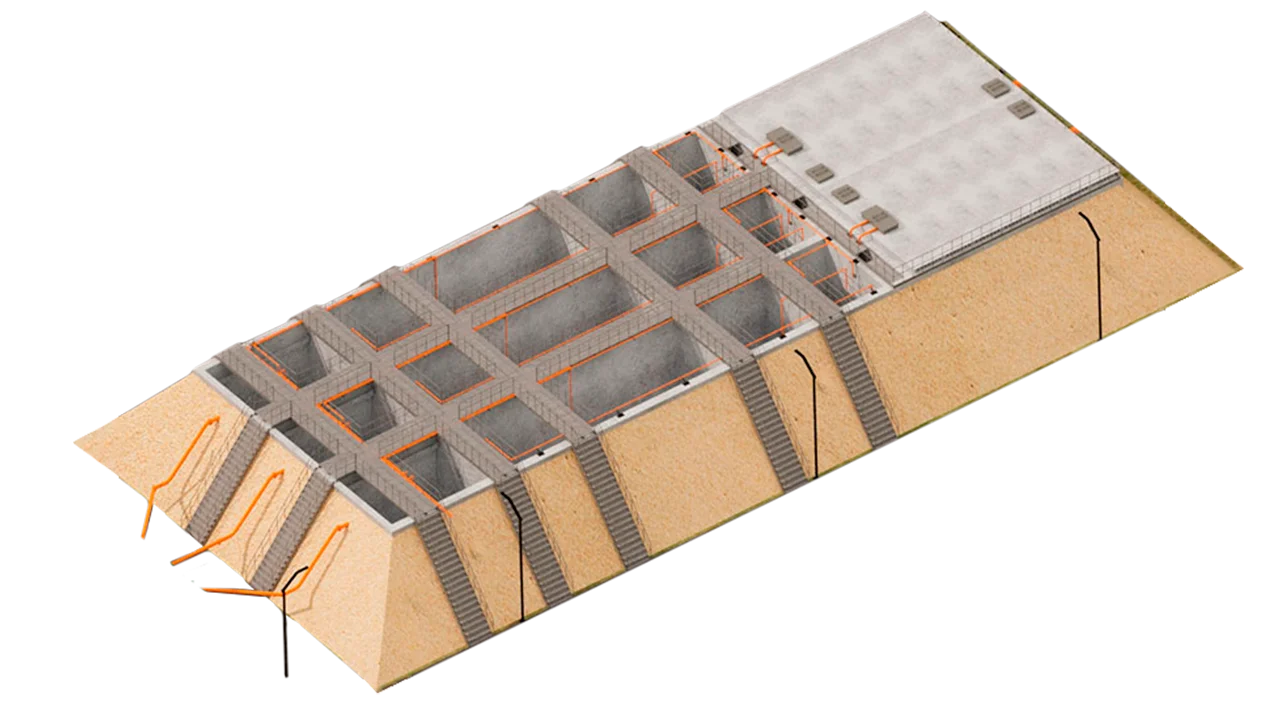
Storm drainage on an industrial site is the most underrated part of any project. As long as the conversation is about roofs and parking, everyone nods. The moment stormwater treatment is mentioned, you hear: «It is just rain – why treat it?» The answer becomes obvious after the first environmental inspection and a fine with six zeros on it.
Rain falling on a factory, warehouse or motor pool is not the water that drops from the sky. As a drop moves across the roof, the asphalt, the open scrap yard, or an unloading bay, it picks up everything on the way: petroleum products, suspended solids, heavy metals, salts, oil residues. By the time it reaches the stormwater manhole, its COD and BOD are indistinguishable from a domestic effluent. Sometimes they exceed it.
The Uzbek State Ecology Committee reads discharges like this in one way: releasing untreated stormwater to a water body or to the ground counts as environmental pollution. Fines for a legal entity start at 100 base calculation units and scale rapidly on repeat offences. Add a suspension order until the issue is fixed. It is easier to install treatment once than to dodge inspectors every spring.
What actually needs treating. Site stormwater splits into two streams – conditionally clean (roofs, lawns, decorative areas) and contaminated (fuel stations, unloading, parking, metal storage yards). The first can be released after a settling tank. The second goes through the full chain: grit trap → oil separator (gravity or coalescent) → sorption filter. At the outlet, parameters must fall within limits: petroleum products no more than 0.05 mg/L, suspended solids up to 3 mg/L, COD up to 30 mgO₂/L.
How capacity is calculated. The SNiP formula is simple: flow = site area × runoff coefficient × rain intensity. Design intensity for Tashkent is 90 L/s per hectare over a 20-minute storm. A real example: a 5-hectare site with a 0.7 runoff coefficient (lots of asphalt). Peak flow – 315 L/s, or 1130 m³/hour. That surge is exactly what the throughput of the flow-splitter chamber and the buffer tank in front of the treatment train needs to be sized for. A 20 percent underestimate means an overflow into the emergency bypass.
Technology options. The simplest solution is a flow-splitter with a bypass gate: the clean fraction goes untreated, the dirty fraction gets stored and treated. Cuts capex by 60-70 percent. A more serious approach is a modular plant with the full cycle, including UV and a biofilter. Used when the site is next to a first-category water body or when treated water needs to be recycled for irrigation.
Design-stage points to watch. First – grading and layout. If the storm network reaches the plant under pressure, an additional dissipation chamber is required. Second – seasonality. Peak flow is in March-April, minimum in July-August. The plant should not sit dry all summer – the biological stage dies without organic load. Third – snow. In March, meltwater carrying salt and de-icing agents runs off roofs and yards; sorption filters only survive those peaks if they include a regeneration loop.
Budget guidance. A local system for a 500-1000 m² parking lot – 30-50 million UZS. A modular unit for a mid-size production site up to 2 hectares – 120-200 million UZS. A full complex for a large enterprise of 5 hectares and above – from 400 million and up, installed. Timelines run from 1.5 months for a simple system to 4-5 months for a full project including environmental review.
Bottom line. Stormwater treatment is not «fine insurance» – it is a normal piece of infrastructure for an industrial site. Designed correctly, it works 20 years without interfering with the main production cycle, removes the risk of environmental claims, and in a number of cases returns water for irrigation, which is money in itself.


Scan the QR code to go to our Telegram channel


 92, Navoi st., Chirchik city, Republic of Uzbekistan
 +998 55 900 17 00
 info@tehmash.uz