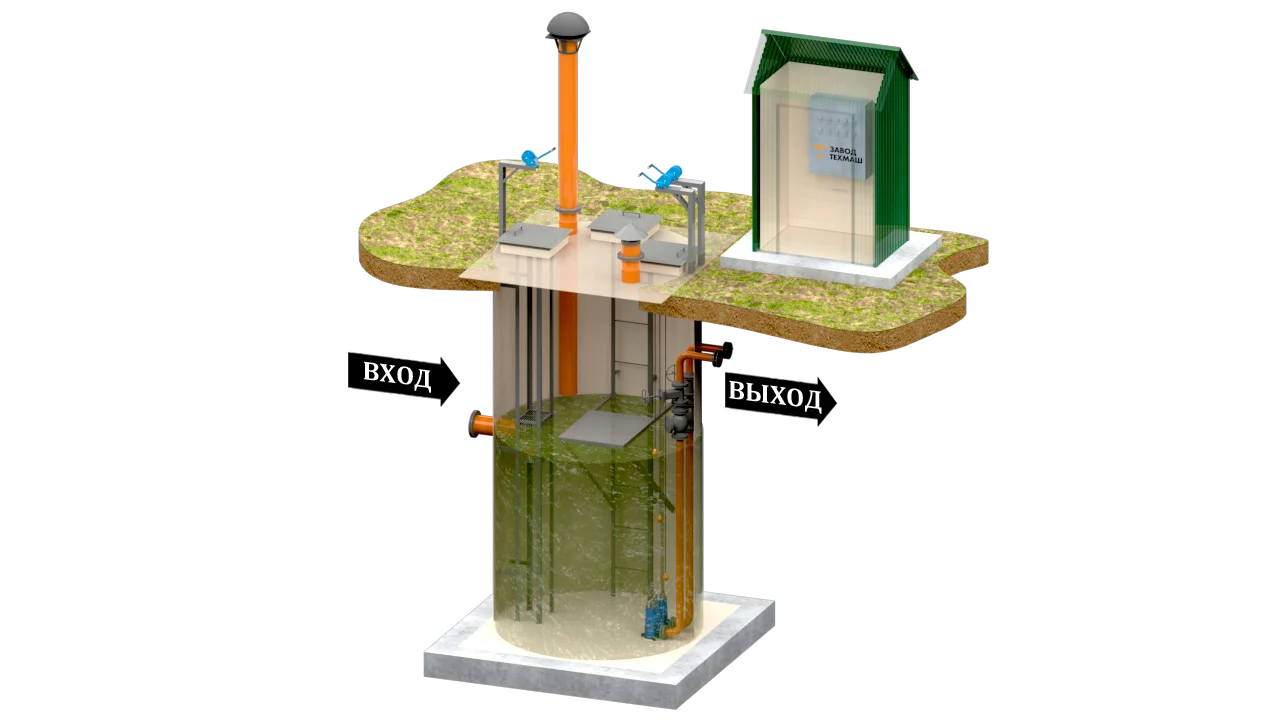
Gravity is reliable, but it has one weakness – it only works downhill. The moment your line has to climb, or run flat for more than 300 metres, gravity flow gives up. That is where a sewage pumping station enters the picture: a sealed vessel with pumps whose job is to lift or push wastewater to a point it will not reach on its own.
Inside, the logic is straightforward. A receiving tank collects gravity flow from the building. One or two submersible pumps sit at the bottom, controlled by a float or hydrostatic level sensor. Once the water reaches the upper mark, the pump starts and pushes the flow through a non-return valve into the pressure main. Once it drops to the lower mark, the pump stops. All of it automatic, no operator required.
Pumping stations differ along three lines. By installation – buried (a capsule sunk 4-8 metres into the ground) or above-ground (in a dedicated room). By effluent type – domestic, industrial or storm; each has its own pump. Domestic gets a fecal pump with a cutter; industrial gets a stainless-steel unit resistant to chemistry; storm gets a high-throughput drainage pump without complicated mechanics. By pump count – single (for a private house), duplex with auto-swap (for commercial buildings), and triple (for neighbourhoods, two in operation, one on standby).
The working principle of even the most complex station comes down to three verbs: arrive, store, discharge. The level sensor sees the water rise and signals the control cabinet. The cabinet starts the pump on a soft ramp, and the pump pushes the flow through the check valve into the pressure line. While one pump works, the other is on standby. On the next cycle the second one starts – so both wear evenly. If the leading pump cannot keep up, say during a laundry’s peak discharge, the automation runs the reserve in parallel.
Where you simply cannot avoid an SPS on the Uzbek market. First – basement bathrooms and cellars. The discharge point sits 2-3 metres below the street sewer, and without forced pumping the toilet just does not work. Second – sites with long horizontal runs: logistics parks, warehouses, shopping centres. Laying 500 metres of gravity line means a 5-metre slope drop, and that is an extra excavation and several million extra sum on the estimate. Third – new residential complexes and cottage settlements whose tie-in point to the city sewer sits in an awkward spot.
What to look at when specifying. Capacity – sized on peak flow with a 1.3 multiplier. Head – geodesic lift plus friction losses in the pipe (typically add 2-3 metres of reserve). Pump type – for domestic use, always with a cutting impeller, or toilet paper and hair will turn the unit into a brick within a fortnight. Housing material – fibreglass or polyethylene; steel bodies rarely survive more than 5-7 years in the high-water-table soils common around Tashkent.
Market pricing: a domestic SPS up to 5 m³/hour runs 8-15 million UZS; a commercial 20 m³/hour unit lands at 40-70 million; industrial from 100 m³/hour starts at 150 million and goes up. Installation – excavation, piping, wiring with automation – usually adds another 40-60 percent on top of the station itself.
One detail projects often skip. The reserve level. If power goes out for six hours, the receiving tank has to hold whatever the site generates in that window, or the sewage will surface outside. A workable reserve is 30-50 percent of the daily flow. Cutting corners on tank volume is a guaranteed twice-a-year overflow event.


Scan the QR code to go to our Telegram channel


 92, Navoi st., Chirchik city, Republic of Uzbekistan
 +998 55 900 17 00
 info@tehmash.uz