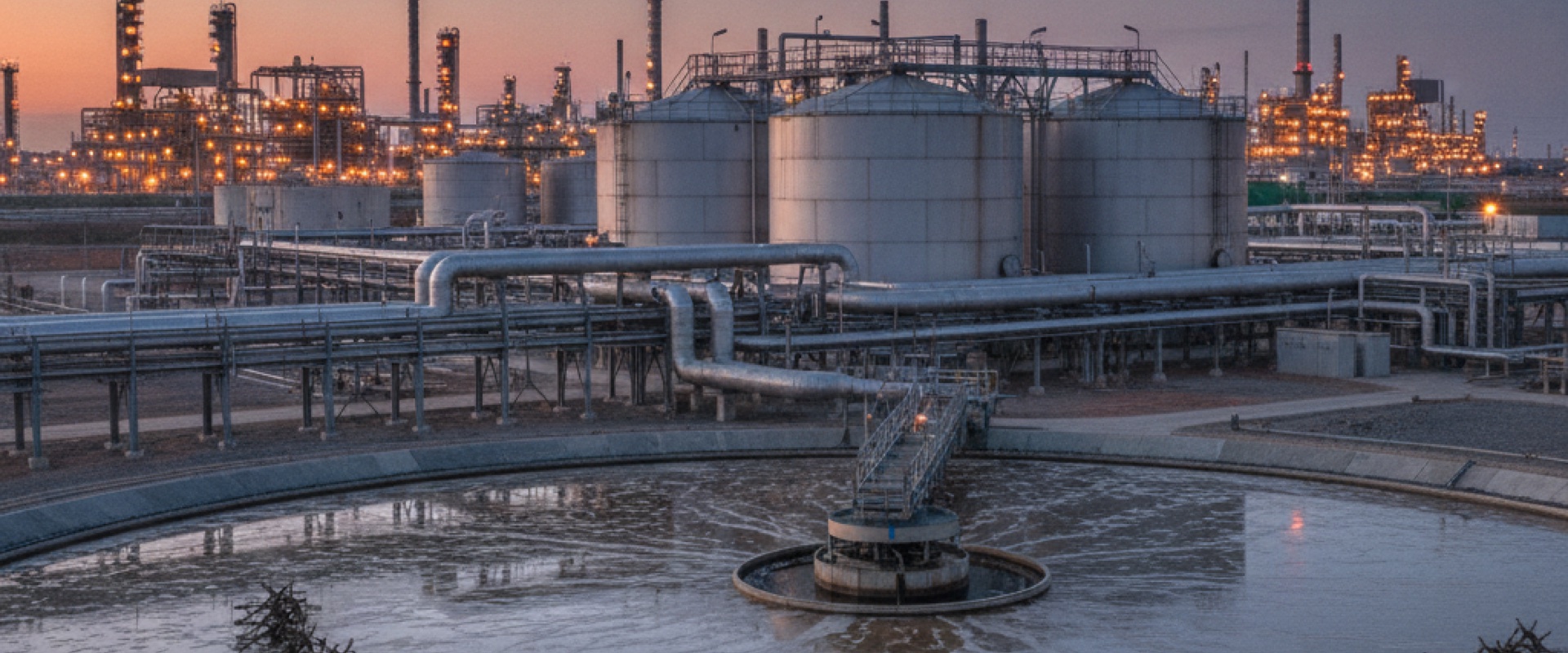
Oil, gas and chemicals are their own league in wastewater treatment. A standard biological plant that runs cleanly on food processing or laundry effluent will die in a week from a single tanker of process water. The reason: a very specific pollutant mix that classic aerobic bacteria cannot handle, and which requires combined 4-6 stage schemes.
What is actually in the water. Oilfield effluent — emulsified hydrocarbons (10-500 mg/l), phenols, sulphides, mineralisation up to 100 g/l, mechanical solids (sand, clay). Gas plant effluent — glycols, methanol, amines, condensate with dissolved hydrocarbons. Chemical industry effluent — acids, alkalis, organic solvents, heavy metals, synthetic surfactants, halogenated organics. Each group needs its own technology, and trying to run everything through a single bioreactor produces water that meets none of the required outlet parameters.
The treatment chain for oil-bearing effluent follows a classic scheme: gravity oil separation (API-type interceptors) → dissolved-air flotation (DAF units) → coagulation with flocculants → biological polishing → activated carbon sorption or membrane. The first two stages take out 90-95% of hydrocarbons directly, flocculation captures the emulsified fraction, biology consumes dissolved hydrocarbons, and sorption traps residual chlorinated compounds. Skip any stage and you discharge effluent that carries a State Ecology Committee fine starting at 100 million UZS.
Chemical effluent needs a different approach. Reagent treatment comes first: pH neutralisation (lime for acids, sulphuric acid for alkalis), precipitation of heavy metals (hydroxide or sulphide), organics oxidation (hydrogen peroxide, Fenton, ozone). Only after that does biological treatment make sense, because a live bacterial colony dies at pH below 5 or above 9.5. For halogenated organics and polycyclic hydrocarbons we use advanced oxidation processes (AOP) — an ozone-UV combination that generates hydroxyl radicals.
The equipment that actually works in these industries is not what sits in Chinese trading-house brochures. You need: DAF units (Nijhuis, Hydroflux, Andritz), membrane filters with ceramic or PVDF media (resistant to oil and solvents), 316L or duplex stainless steel for acid-contact surfaces, and Zone I explosion-proof electrical fit-out throughout. Cutting corners on build quality is not an option — an accident at a petrochemical site stops being a fine and becomes a criminal case.
Uzbek project pricing. A small oil-depot unit (20-50 m³/day, 100-300 mg/l hydrocarbons at inlet) — 800 million to 1.5 billion UZS. A refinery-grade complex for a mid-sized plant — 5 to 15 billion. A chemical facility handling surfactants and heavy metals — from 3 billion for a 100 m³/day project. Timelines run 8-14 months including design, construction and commissioning. Do not compress commissioning: without proper adaptation of the biological colony, the plant will not hit spec until 4-6 weeks after first start-up.
Indicative project cost. The figures above are approximate and are provided only for general budgeting purposes. The final cost of a treatment plant depends on many factors, including wastewater analysis results, the required treatment level, throughput capacity, equipment configuration, and site-specific conditions. A precise commercial proposal with detailed pricing is issued only after we review the input data and complete the engineering calculation for the project.
One point rarely stated aloud. In oil, gas and chemicals the client is not buying equipment, they are buying a guarantee of compliance with discharge norms. A bad supplier sells a handsome plant that meets 60% of parameters in the lab report. A good supplier signs a contract with liability for meeting 100% of requirements, and if their scheme falls short they add extra stages at their own cost. That contractual clause is the first thing to check — before price, before timeline.


Scan the QR code to go to our Telegram channel


 92, Navoi st., Chirchik city, Republic of Uzbekistan
 +998 55 900 17 00
 info@tehmash.uz