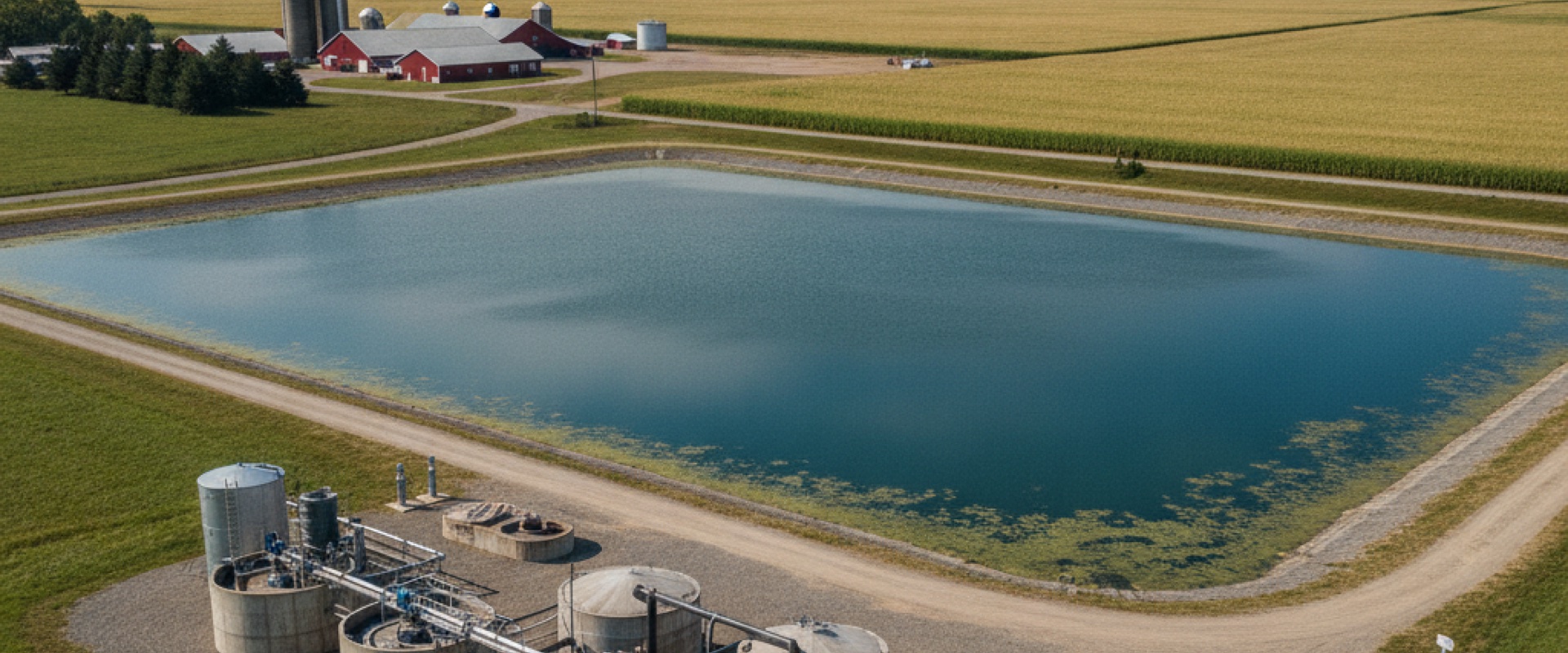
Agricultural effluent is its own headache because it is simultaneously biologically «rich» (high organic load, lots of nitrogen and phosphorus) and full of specific contaminants that kill classic biology. Veterinary drugs in pig-complex effluent, pesticides from greenhouse beds, disinfectants from dairy shops — all of it demands an individual scheme for each facility type.
Livestock farms produce the hardest effluent: manure slurries with 3-15% dry solids, BOD from 5000 to 30 000 mg/l, ammonia nitrogen 500-2000 mg/l. Feeding such concentrations straight to biology does not work — the bacterial colony cannot cope. The correct scheme: solids separator (screw or drum) → anaerobic reactor with biogas generation → aerobic stage for nitrogen and phosphorus → polishing. A by-product is biogas, capable of covering 30-50% of the farm's electricity need. A 5000-head pig complex produces 200-300 kWh of biogas per day — a full-blown small power station.
Greenhouse complexes bring a different profile: relatively clean water in organic terms, but high in nitrates, phosphates and plant-protection residues. Here we use a classic MBR (membrane bioreactor) scheme with reverse osmosis for recirculating water back into the greenhouse. The economics work: a 5-hectare greenhouse consumes 150-300 m³/day, and after treatment 80% goes back into the loop. Water savings run 40-70 million UZS/year and the unit pays back in 2-3 seasons.
Processing facilities (dairy, meat, vegetable) need a combined technology. Dairy — fats and proteins, BOD 3000-6000 mg/l. Meat processing — fats, blood, bone meal, BOD up to 8000 mg/l. Vegetable processing — starch, sugars, acidic effluent from pickling. Standard scheme: equalisation tank (to smooth out slug loads from equipment washdowns) → grease separation → anaerobic stage → aerobic biology → polishing. The critical piece is a 12-24 hour equalisation tank; without it the daily washdown slug kills the biology every week.
Uzbek specifics. First — seasonality. Winter cuts biological activity 2-3× and fruit-vegetable processing largely stops in winter — the plant must be able to run in «maintenance» mode without a full shutdown. Second — soils. In cotton regions, saline soils and a high water table push you to sealed fibreglass tanks instead of earthen lagoons. Third — water as a resource. Given the Aral basin water shortage, polishing to reclaim-water quality has stopped being a nice-to-have and is now a mandatory line item in the TU.
Pricing reference. A 200-500 head cattle farm — a compact plant at 30-60 million UZS. A 5000-head pig complex with a biogas plant — 2-4 billion UZS, payback in 5-7 years through biogas plus manure-handling savings. A 5-hectare greenhouse complex with MBR and recirculation — 400-700 million UZS. A dairy plant processing 20 tonnes/day — 500-900 million UZS. None of these figures include state subsidies: since 2024, under the eco-production support programme, the government of Uzbekistan compensates up to 30% of treatment plant cost for agricultural enterprises.
Indicative project cost. The figures above are approximate and are provided only for general budgeting purposes. The final cost of a treatment plant depends on many factors, including wastewater analysis results, the required treatment level, throughput capacity, equipment configuration, and site-specific conditions. A precise commercial proposal with detailed pricing is issued only after we review the input data and complete the engineering calculation for the project.
What matters at the design stage. Insist on seasonal effluent analysis (summer peak flow, winter minimum temperature) and per-shift analysis (washdown ≠ core production). Always design in a buffer tank for slug loads during sanitation cycles. And always design for 30-50% future expansion capacity — Uzbek agriculture is growing fast, a farm can double its herd within 3-4 years of start-up, and it is cheaper to build in headroom than to redo the project later.


Scan the QR code to go to our Telegram channel


 92, Navoi st., Chirchik city, Republic of Uzbekistan
 +998 55 900 17 00
 info@tehmash.uz