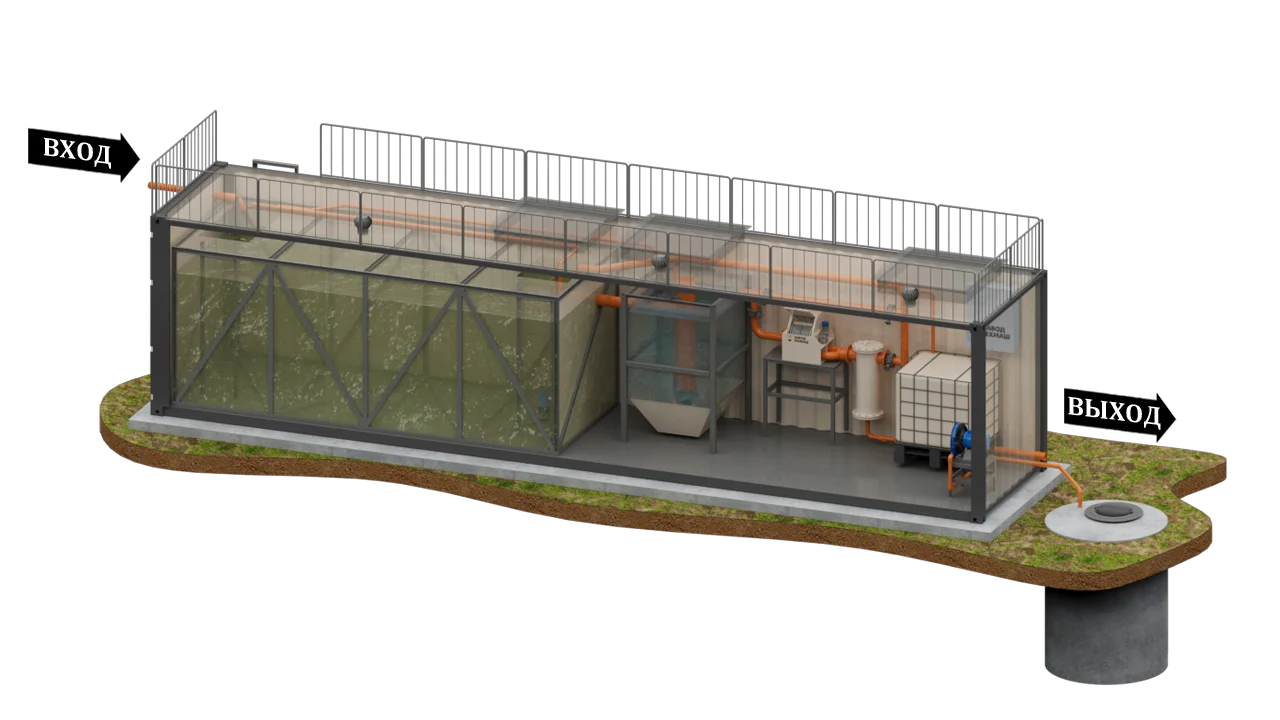
Once a site sits more than a kilometre from a city sewer, the question of «what do we do with the wastewater?» turns into a standalone engineering project. That is where local wastewater treatment plants come in – compact units that receive domestic or industrial effluent, bring it to the required discharge standards, and only then send it into the soil, a water body, or back into the plant’s own cycle.
The design of an LWTP is simpler than it looks. The intake chamber holds back solids, sand and grease mechanically. From there the flow enters a bioreactor, where a colony of aerobic bacteria breaks organic matter down into settled sludge and CO₂. A secondary clarifier follows: sludge drops to the bottom, clarified water rises. The last stage is polishing – sand or membrane filters and disinfection by UV or hypochlorite. What leaves the plant is cleaner than what most households pour out of the tap.
Three scenarios make an LWTP unavoidable. The first is cottage settlements, hotels, resorts and industrial sites outside the city. There is no municipal sewer to tie into, and a soakaway with a filtration field is 20th-century thinking that keeps drawing fines from sanitary inspectors. The second is food-processing shops, car washes, service stations, laundries – effluent packed with fats, surfactants and petroleum products cannot legally be dumped into a city network; utilities charge overage fees first and cut acceptance later. The third is production with recycled water, where treated effluent goes back into the process. Here the LWTP pays for itself through freshwater savings.
Capacity is picked by flow. A private house for five people needs 1-1.5 m³/day. A small restaurant, 5-10 m³. A garment factory with 300 workers, 30-50 m³. A four-bay car wash, 8-12 m³ with a mandatory oil-water separator. Sizing errors are costly. An undersized plant chokes within a quarter; an oversized one idles, which is almost equally damaging to the aerobic biology that lives inside it.
There are three things a client should understand before signing. Ground. Clay-heavy soil and a high water table push you toward a plant with forced discharge and a holding sump. Climate. Tashkent winters rarely drop below −15 °C, but filtration fields still need to sit below the frost line. Service. A biological plant needs air; if the compressor stays down for a week, the bacterial colony dies and the treatment cycle has to be restarted from scratch. That is why a reputable supplier will always fold a yearly maintenance package into the contract.
Pricing in the Uzbek market: a residential turnkey plant runs 25 to 60 million UZS installed; an industrial unit from 30 m³/day starts around 250 million and up. Payback on an industrial site typically lands at 2-3 years once you count avoided environmental fines and municipal discharge fees.
Bottom line. An LWTP is not a luxury and not a «green» accessory – it is a normal piece of engineering that keeps an out-of-town facility legally operational. Sized correctly, it runs 15 to 20 years and reminds you of itself two or three times a year, when the service crew arrives to pump out surplus sludge.


Scan the QR code to go to our Telegram channel


 92, Navoi st., Chirchik city, Republic of Uzbekistan
 +998 55 900 17 00
 info@tehmash.uz